Feeds:
Posts
Comments

Archive for the ‘Nature’ Category

Dent de lion

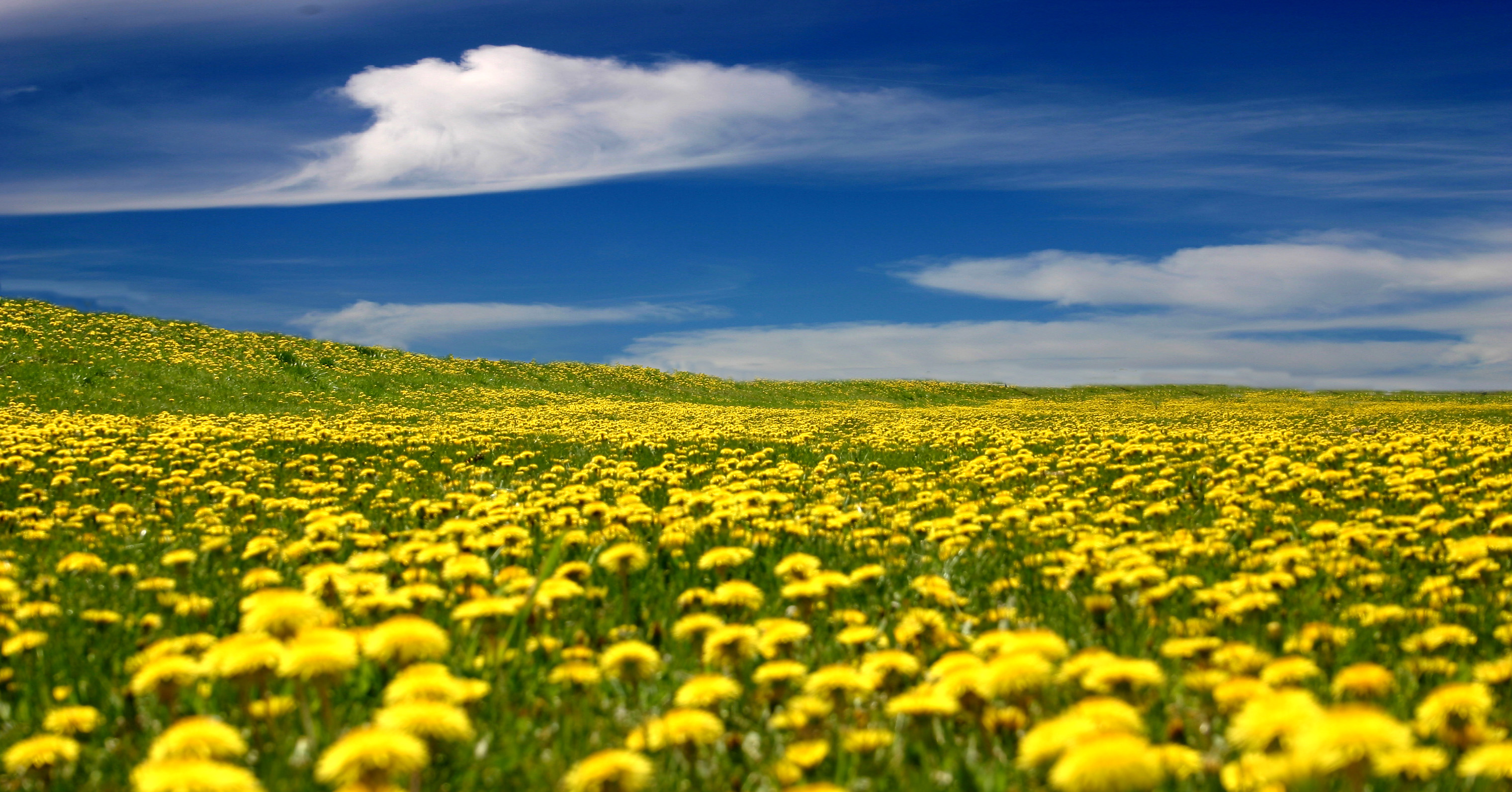
fields of dandelionsIs the dandelion the “flower” of the spring season?

It seems so! They have proliferated in so many gardens this year, particularly front gardens and verges, whether people like them or not. With so many dandelions in bloom, they have woven a carpet of yellow, which can be easily confused with oilseed rape about to appear in farmers’ fields and hedgerows.

Dandelions (from the French “dent de lion”, depicting their sharp lion tooth-like leaves) are classed as a weed – a plant that grows where it is unwanted! Dandelions are thought to have evolved about thirty million years ago in Eurasia and have been used as food and medicine for much of recorded history. The dandelion has diuretic properties and provides a source of nectar for most insects.

I remember collecting dandelion flowers from fields and roadside verges years ago for a relative who made a very invigorating white wine from them and just a hint of Pinot Grigio!

Would you believe that the Germans have tested tires made with a blend from dandelion-rubber and are scheduled to test them on roads during the coming years.

A tortoise I “rescued” from a pet shop years ago named Napoleon, survived by his ‘girlfriend’ Josephine, both believed to be over 50 years, loved to munch on dandelions, leaves and flowers. I believe dandelions extended their lives. Who knows, maybe dandelions could extend our lives too. Having said that, tortoises on the Galapagos live to 100 and there is only the roughest vegetation available to them.
Read Full Post »

Photo credit - sandiquiz

Photo credit – sandiquiz

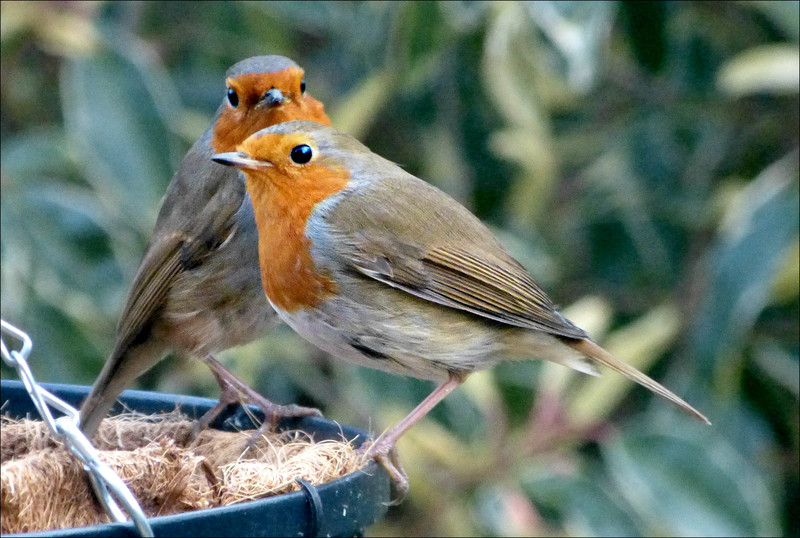
Gathering in the washing from the line this afternoon, I was greeted by that cheery chirp of the garden or European robin.

Actually calling him “robin redbreast” is deceptive, because it has a distinctive orange breast. This is because the colour orange was unknown in the English language until the 16th century.

The European robin is one of many species originally described by Linnaeus in his 18th century work. It prefers spruce woods in Northern Europe, contrasting with its preferences for parks and definitely gardens in our British Isles.

The robin is considered generally to be the gardener’s “friend” and for reasons of folklore – should never be harmed! They are generally unafraid of people and much drawn to human activities involving the digging of soil, in order to look for grubs and worms. My cheery garden friend is no exception and follows me around to see if I am going to unearth a wriggly accompaniment to the daily allocation of sunflower hearts I distribute. The robin can also be a night “flitter” and has been observed actively hunting insects on moonlit nights.

Would you believe European robins can be found in Fuerteventura. Very surprising, as the species does not breed either on that island or on neighbouring Lanzarote. They are actually wintering on the islands or just passing through during migrations between Africa and Europe.

Which makes me wonder… has “my” garden robin just arrived from Lanzarote?

I will never know. But it surely does.

Read Full Post »

Are ants political?

imageAnts are fascinating creatures. I watched one scupper across my table, avoiding the sugar I had mischievously placed in its way. It had a higher purpose. An objective beyond the game I wanted to play with it.

Ants start life as an egg. If fertilised, the progeny will be female. If not, then male – in itself quite amazing. I wonder what that says about male ants ! Their lives are the shortest – just 3 years, whereas queens can live for up to 30 years.

Ants can form colonies of varying sizes – from just a few living in a crack in the wall, to highly organised colonies of millions that infiltrate large territories.

They are socially ‘engineered’ with mathematical precision – workers, soldiers and other specialists. New workers spend the first few days of their adult life caring for the queen. Young and ‘graduate’ ants dig and do house work.

Ant society has divisions of labour, communication channels and an ability to solve complex problems. Each member of the community knows its place, its role, its purpose. There are no cases of unrest, disorder, strikes or mutiny. Their instinctive ability to modify habitat and tap resources and defend themselves is something we humans observe in awe.

image

The last TV debate – reinforcing divisions rather than advancing the debate

They exist for their mutual success. They are selfless. Humans on the other hand are self-aware so motivated by individual success. And this I suppose, is why our society will never function in the same way. Maybe that’s a good thing, but at times, when I watch the news and political debates like the last one, I do wonder.

Ants execute a social formula. A social formula that can only be embedded in their DNA. Otherwise how do they acquire it ? They have no forum for debate, no democratic elections, no opposition. They enter life and just get on with it – and do extremely well.

Ants seem to be born with politics – the same politic – in their ‘souls’ for the service of the community at large. Now that’s something all politicians can learn from.

Read Full Post »

Rats are revered for their intelligence

Rats – revered for their intelligence

The English dictionary describes “the rat” as a rodent resembling a large mouse – both considered serious pests capable of passing on disease. The average lifespan of a wild rat is about a year due to predation. The common species are opportunistic – mostly living near humans. They cause substantial food loss in developing countries.

After just watching a TV programme about pest control, I was amazed at how quickly they can multiply. Junk piling up in sheds and gardens provides a natural habitat for “nasty” rats. That made me observe my immediate neighbourhood more closely, which on the surface seems neat and tidy but on closer inspection with my new-found knowledge is a potential haven for rats.

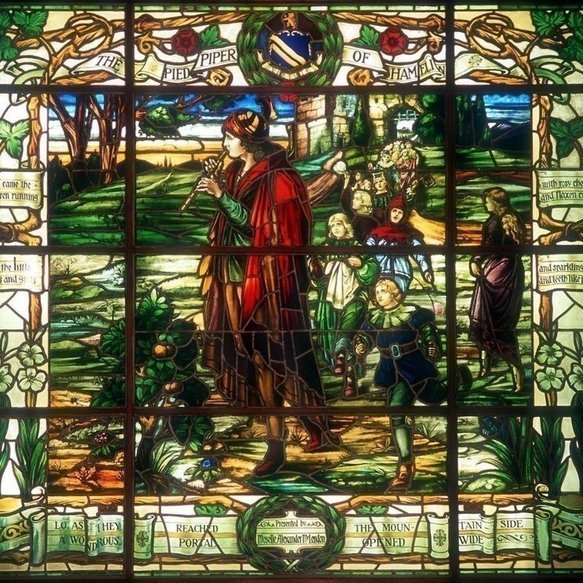
Pied Piper of Hamelin - said to be based on a true story. Stained glass Hamelin church window.

Stained glass Hamelin church window depicting the Pied Piper of Hamelin – said to be based on a true story.

This put me in mind of the 16th century “Pied Piper of Hamelin”  folklore about that German city’s rat problem. The rat catcher’s magic pipe lured away the vermin, but when the citizenry refused to pay him, he retaliated angrily by turning his pipe’s magic powers on the children. Some say he returned the children after being paid, others that he took them to a beautiful land. The earliest known record of the story is within the church of Hamelin itself – depicted in its stained glass window.

That made me wonder – are rats musically inclined? Experiments have shown that music stimulates their ability to reason. Maybe there is something to the story – they are, after all, revered for their intelligence and have demonstrated compassion – arguably more than humans.

Laboratory rats have also proven valuable in psychological learning studies and other mental processes. Their ability to learn means they get used in problem solving tasks and simple avoidance conditioning. A good example of how useful rats can be is in Africa, where they are trained to detect landmines and can even detect tuberculosis by sense of smell.

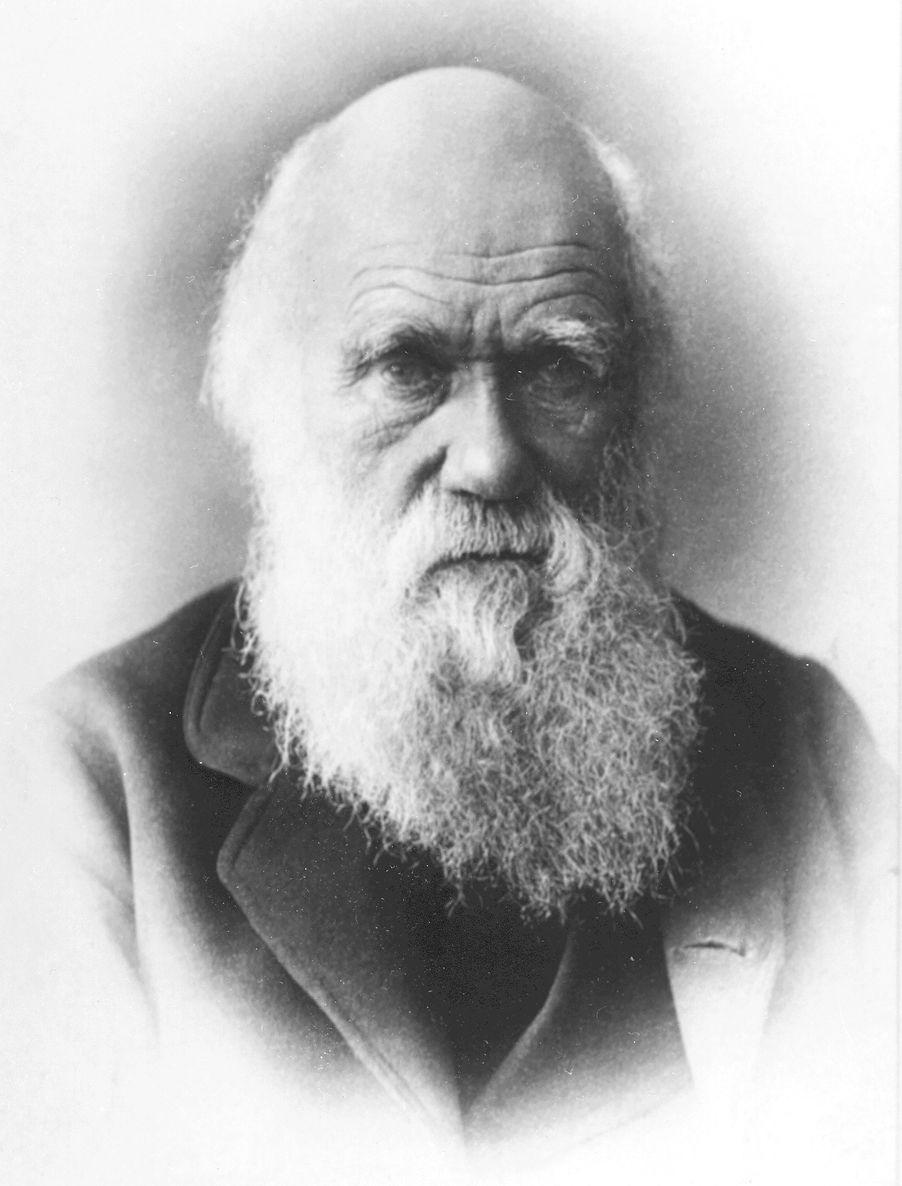
darwin

Charles Darwin, 1809 – 1882. Author of “The Origin of Species”

As Darwin illustrated so profoundly – any being is the product of its environment. In junk, rats are pests. In the right hands, they save human lives.

Read Full Post »

A British sign of spring

bluebells_2234194b Matt Binstead

Photo: Matt Binstead

Spring is almost here. A wonderful season of new-born animals and birds – when nature’s spark sets off another renaissance in gardens, hedgerows and woodlands throughout the countryside.

There is nothing more remarkable than the bluebell – usually first to cast its leaves long and wide to the surface. The flowers are deep violet or blue and what a joy it will be to see so much blue again in the garden. This spring will be a bumper year as the bulbs have propagated with time; just like their snowdrop bed mates, purchased from reputable garden centres.

Did you know that Britain contains more than half of the world’s population? Some common names for the bluebell are “harebell“, “auld man’s bell” and “wild hyacinth”.

BluebellsI remember as a young girl, we would go as a family to gather bluebells and primroses in the woods in Bedfordshire. The flowers did not survive long. But it was a joy to see their floral display in vases.

The main threat to their survival is people picking them and illegally digging up the bulbs. That is why it is now forbidden by UK law to gather wild bulbs from woodlands and hedgerows – punishable by a fine of £5,000 per bulb and up to 6 months imprisonment! Quite right too. You live and learn!

Read Full Post »

Photo copyright: Mark Adams

“Maman” by Louise Bourgeois Photo copyright: Mark Adams

I was intrigued by zoologist Dr. Tim Cockerill’s BBC4 “Spider House” programme last week, whose purpose it is to correct the bad press spiders tend to get. He is an excellent presenter and I didn’t know that he’s a local – from Sutton, east Hull.

Dr. Tim Cockerill

Dr. Tim Cockerill

The programme is very timely, as I always get several huge house spiders scuttling around the borders of the room this time of year. Not large enough to cast shadows though! Now I know they’re shopping for a male to further the species and also provide a post-coital supper.

It brings to mind the more than 10 meter, eye-catching spider that sits in front of the Tate Modern suitably named “Maman”; the work of French-born artist Louise Bourgeois.

There’s a second giant spider in Liverpool, this time called “La Princesse”, created by another French artist François Delarozière, commissioned to inaugurate their year as cultural capital in September 2008.

La Princesse by Delarozière Photo copyright: Matthew Andrews

La Princesse by Delarozière
Photo copyright: Matthew Andrews

That one is 15 meters high, weighs 37 tonnes and is made from reclaimed steel and poplar wood.

It’s interesting to see how arachnids capture the imagination, usually in some form of anxiety. As Dr. Tim Cockerill points out, they are neither monstrous nor scary.

Which leads me to my next thought, I wonder what Hull has in mind to mark its City of Culture year in 2017. Perhaps Hull’s very own zoologist, Dr. Tim can advise them!

Read Full Post »

Save Africa’s wildlife

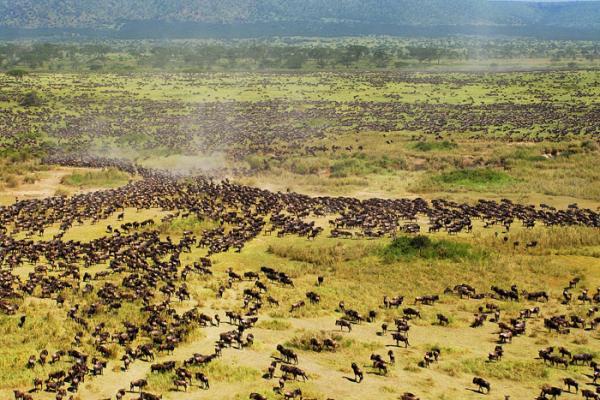
Up to 500,000 wildebeest migrate through Africa's Serengeti

Up to 500,000 wildebeest migrate through Africa’s Serengeti – but numbers overall are in decline

The future of Africa’s wildlife is hanging in the balance. Lions, cheetahs and hyenas are all experiencing declining populations. These animals once roamed majestically across the African continent. Today they can only be found in pockets of their former wilderness.

The once vast herds of grazing animals that follow climatic seasons in search of fresh grass across the plains have been decreasing for decades. The wildlife organisation SAVE is working to recover declining wildebeest populations.

And what of the elephant and rhinoceros poached for their tusks on demand by an insatiable oriental appetite for ivory?

An endeavour to keep Africa’s people free from the scourges of disease is paramount, but let’s not forget the fragile African ecosystem that depends on this fauna too. Let’s not develop a taste for Africa wildlife on our western dinner tables, that can only accelerate its extinction.

I am not a purist when it comes to being a vegetarian. I am all for encouraging the consumption of “home grown” free range produce so that we can avoid endangering the world’s more exotic wildlife.

Read Full Post »

(c) 2012 Ron McCombe.

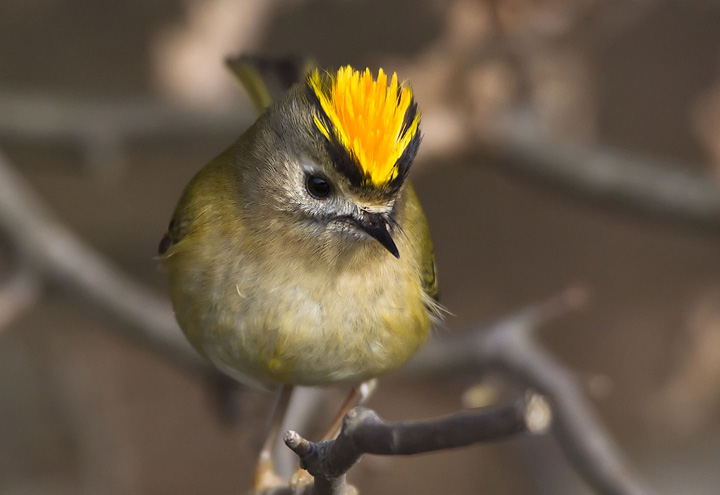
A Goldcrest (c) 2012 Ron McCombe.

The answer is: the season of spring, when birds and animals are preparing to enjoy the coming months with new birth and hopefully continuing warmth and sunshine. My garden has a semi-wild area containing shrubs, bushes and a “stopped-in-its-tracks” real-life, pitifully shortened, Redwood tree. It’s probably a quarter of its natural size. I have to think of the neighbours.

Located in my randomly organised garden and centrally situated is a bird bath. I walked in its direction to see who and what was enjoying a drink. A remarkable sight, no heavier than a 5p coin – a Goldcrest. Having wintered here in Yorkshire, it must surely be on its return journey to Scandinavia. This tiny insectivorous bird enjoying a refreshing drink in my garden, survives our somewhat erratic mild to severe British winters. It will now proceed on its long journey, heading over the North Sea waves to its homeland, undoubtedly to breed and return late autumn to winter in Yorkshire once again.

Read Full Post »

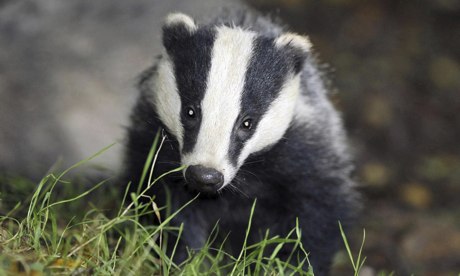
The collapse of the badger culling trial in Gloucestershire represents a humiliation for the government’s policy on reducing bovine TB. Photograph: Ben Birchall/PA

Badger’s paying the price of Britain’s milk factory system.
Photograph: Ben Birchall/PA

At last this Governments’ Environment Agency has listened to the vast majority of people throughout the South West. Its hugely unpopular cull of Britain’s best known animal – Brock the Badger – has been called off.

We nature lovers must thank Brian May and his consistent bombardment of the Environment Minister’s Agency with facts that were being ignored until NOW.

Many farmers disagreed to the cull and they must be applauded too. They claim that some breeds of fine cattle are bred without their natural immunity that used to protect them. It’s up to farmers to keep their herds clean and free from infection, rather than this mass slaughter just because some farmers cannot cope with the extra effort. Cattle these days are just a pawn in a milk factory system that governs the price of milk!

So to those farmers that support the cull, clean up your farms – don’t provoke the slaughter of wildlife that has the same right to life as your factory bred dairy cows.

Read Full Post »

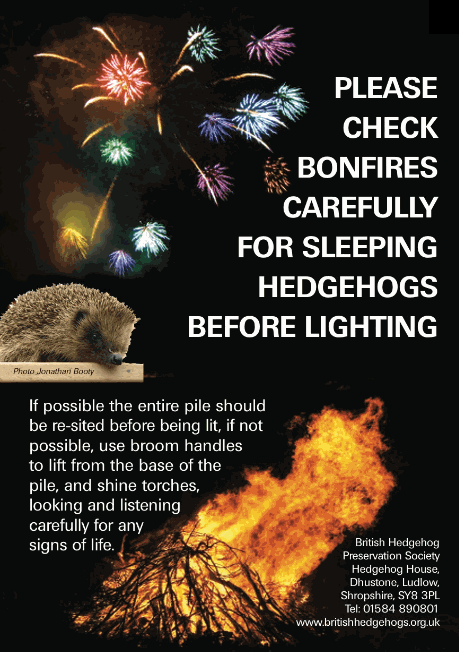
British Hedgehog Preservation Society Bonfire Night Campaign

British Hedgehog Preservation Society Bonfire Night Campaign

I consider some of my garden guests to be “aliens” – but not the hedgehog that devours slugs, beetles and other invertebrates that damage and eat our hard-earned gardening produce.

So please check your bonfire site closely for hedgehog activity. Unlike Guy Fawkes, he has no experience of explosives and no sense of history for 1605!

Let’s safeguard all hedgehogs that might think they have a nice safe haven for the winter. Spare a thought for that small animal that rolls itself into a ball at the first sign of danger and will not notice he is nesting inside his own funeral pyre!

More information about preserving our British hedgehogs here.

Read Full Post »

Older Posts »