Feeds:
Posts
Comments

Archive for the ‘National news’ Category

Postman dogLetterboxes are sometimes the bane of the postman/woman.

Why? Well, those forms of correspondence that require extra shove, provide silent, but aggressive canines a great opportunity to snap with the force of a crocodile. It’s a bigger problem than you might think. Apologetic owners usually reveal themselves smugly with dog-in-hand the following day. They caution the postman to be more careful next time. Silence is not always “golden”.

Last week I witnessed such an event. Blood is cheap! Fore (four?) fingers withdrawn in haste, ultimately leading to a rush to A & E and a long wait for treatment, leaving a painful, throbbing protrusion. All caused by a seemingly cute little tail wagging dog… Fashionable dogs can be so aggressive.

On average around nine postmen and women a day are attacked by dogs across the UK with over 3,300 attacks taking place from April 2013 to April 2014, an 8 per cent increase on the previous year. Some of the injuries are horrific. New legislation means owners can now be prosecuted for dog attacks that take place on private property. Dog owners that alarm postmen face criminal prosecution since October 20, 2014 with fines of up to £20,000 or the prospect of theirs pets being seized. So dog owners beware, the postman is biting back! The Royal Mail last year launched a Dog Awareness Week to raise visibility of the problem.

The private letterbox dates back to 1849, when the Royal Mail first encouraged people to install their own letterboxes to facilitate the delivery of mail. Before then, letterboxes of a similar design had been installed in the doors and walls of post offices for people to drop off outgoing mail. An example of such a wall box (originally installed in the wall of the Wakefield Post Office) is dated 1809 and believed to be the oldest example in Britain.  It is now on display at the new Wakefield Museum.

Postmen will be glad to learn that they have nothing more to fear from my letterbox than a slight need for maintenance.

Read Full Post »

I would like to express my sincere thanks to Douglas and the team that so diligently supported me in the field and especially to those that voted for me. A very special mention to David Davies for his support and to David Cameron. Their hard fought campaigns and spectacular victories made it all possible.

Now it’s down to work.


Victory 2015

Read Full Post »

Basic InstinctIt is one thing to seduce public opinion by appealing to basic instincts with emotive, electoral promises about EU membership and immigration. It is another to be able to deliver on those promises once in power. And let’s be clear, those promising simple solutions to the above, will unlikely be able to deliver on them without doing serious damage to our economy and the fabric of our society.

Don’t get me wrong, the questions raised about EU membership and immigration are serious. They are also complex and require carefully thought solutions. I have felt for some time that the illusionary fog forming around the arguments portrayed by certain cult figures is making reasonable debate impossible.

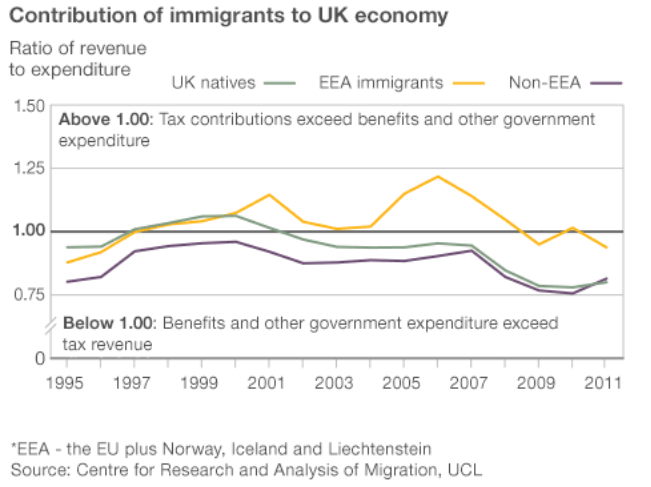
For instance, according to last year’s University College London study “The Fiscal Effects of Immigration to the UK” by professors Christian Dustmann and Dr. Tommaso Frattini, only 0.15% of the NHS budget is lost to ‘health tourism’. Immigrants were actually net contributors for the first decade of this millenium.

The report also states that European immigrants have paid 34% more in taxes than they claim back from the state and that non-European immigrants paid 2% more. Over the same period, British citizens paid 11% less in tax than they claimed back. Immigrants are also 45% less likely to receive state benefits than British citizens and 3% less likely to live in social housing – inconvenient truths for some.

UCL Fiscal Immigration Report

Is it fair then to stigmatise and alienate these people? Are we not pouring more salt onto a wound that is already weeping? Immigrants are easy targets, because we fear the unknown and the unfamiliar – but that does not mean our fear is justified.

True, the report looks backwards, and with the shifting demographic we also need to project forwards to ensure the trend continues. My point is this:  let’s at least have a reasonable debate – based on the facts – rather than current scaremongering.

And is EU membership really a burden on the UK? This seems to me to be a very short-sighted view. The government spends less than 0.5% of GDP on its EU membership. Yet, Britain receives 52% of all its trade from member states. What would happen to the £400 billion a year trade that is today free from customs duties? Protectionism is a two-way street and the EU would certainly react by erecting barriers in the form of trade tariffs that would render our goods less attractive. That would eventually reignite unemployment. More subtle though is the intangible impact separation from the EU would have on international relations. Close trade ties between nations is the best insurance against civil strife that eventually leads to war. Most wars are fermented through some kind of trade imbalance. Did we learn nothing from history?

And what would happen to our freedom to travel, live, work, study, and retire anywhere in the EU? Would we become a more introspective nation? Would we slip down the slope that has captured Russia?

Is anyone listening to these and other arguments?

The short answer must be no. Otherwise how to explain current voting trends? It seems like the “cut the umbilical cord from Europe” answer is winning the day.

Let’s hope that recent election results are simply the manifestation of frustration rather than a deep rooted sea change in collective attitudes.

Let’s listen to all sides of the argument. If we do, common sense rather than basic instincts will prevail.

Read Full Post »


Gordon Brown

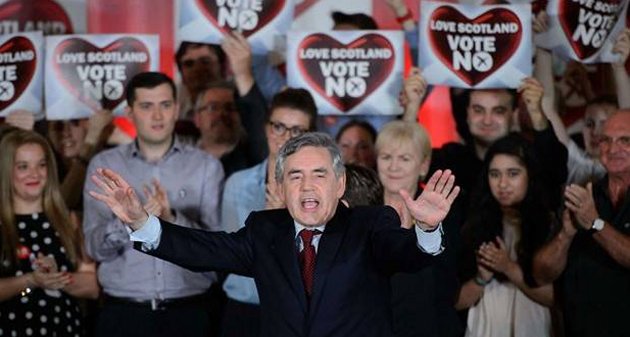
Gordon Brown – passionately defending the ‘Vote No’ cause

A once in a lifetime event that captured the imagination of the world over – that was the Scottish referendum. Some hailed it as a courageous act of democracy on behalf of the British Government, others a needless leap into the unknown. And it very nearly was. At least now the question is settled for a generation.

Despite the media’s talk of a comfortable victory, it was to me, a very close shave. Let’s not forget that close to half of the population voted for independence. I shudder to think what a ‘Yes’ victory would have done to our standing in the world, let alone the administrative mess and cost of untangling Scotland from the United Kingdom.

As the Queen, Westminster Village, British citizens in their majority and Brussels breathe a collective sigh of relief, we can only applaud the victory of the ‘No’ camp and the Scottish people in general for the way this referendum was run. Politicians across Europe are calling it ‘a class act’ – serving as a lesson in democracy to our troubled world. And the manner in which the separatists conceded their defeat will hopefully quickly heal the wounds of the last few days, weeks and months.

Ironically, this victory is likely to weaken Westminster as it picks through the promises and wrestles over their implementation. The Scottish ‘Yes’ camp lost, but Scotland emerges stronger.

I must say that I was surprised at Alex Salmond’s quick resignation. Pushing party politics aside, dare I say that Gordon Brown deserves a shot at the newly open top job?

Read related post here.

Read Full Post »

Ageing House of Lords

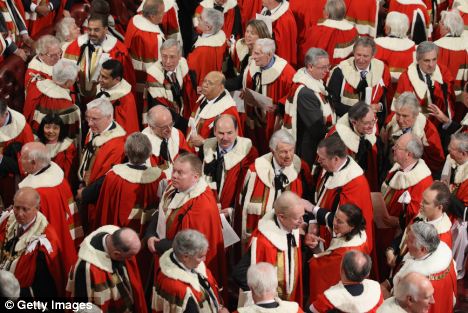
If the House of Lords were representative of the British workforce, the average age of a worker would be 69

Ageism could materialise as an important issue in the 2015 local government elections. According to the last census, over 16% of the electorate are over 65. When you think how tight run elections are these days, that’s a significant number that can swing a vote.

In the UK, laws against ageism are fairly recent. Age discrimination laws were brought into force in October 2006 and can now be found in the Equality Act 2010. This implements the European Commission’s Equal Treatment Framework Directive passed in 2000 and protects people against direct discrimination. There is also a provision in the Equality Act 2010 to prohibit Age Discrimination in the provision of goods and services. All of this legislation hasn’t withheld the rise in the number of complaints and claims however. Cases are expected to reach 15,000 by 2015!

The world’s population is aging, due to falling birth rates and increasing longevity. Here in the UK, the number of people aged 60 and above is expected to increase by 17 percent by 2020, while the number of under-16s is expected to increase by just 7 percent. Contrary to what you might think, this aging trend shouldn’t be a problem – if we get creative, it could actually represent a significant economic opportunity.

Areas that can benefit are i) education for those looking to refresh skills,  ii) the leisure, tourist and entertainment industries, iii) wellness and health spending, and iv) mobile IT health services, to name just a few. Whose going to pay for that? How about lifelong financial services such as tailored equity releases and health insurance?

I only hope that those who discriminate will live long enough to taste their own medicine. Only then will they fully understand the true feelings of the “older generation”. It’s a generation??????????????????????????????????????? that wants to compete on an even footing rather than be denigrated. They want to be praised for their contribution and commitment to society. Many have the maturity, motivation, wealth of experience and stamina to outperform a younger workforce. They should be allowed to share their experience with the rest of society if they so choose. It is a fallacy to think that just because someone is younger, they are fitter for a particular purpose.

Take the median age in the House of Lords – currently 69; and it is an ageing population. Only 17% are below the age of 60, 50% are over 70 and 18% are over 80! If we are able to entrust the country’s legislation to these ageing professionals, surely we can apply the same reasoning to the rest of the ageing professionals and willing souls in society.

You might even say that the House of Lords is a model of how to care for the elderly.

Read Full Post »

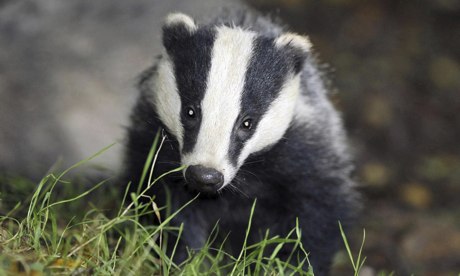
The collapse of the badger culling trial in Gloucestershire represents a humiliation for the government’s policy on reducing bovine TB. Photograph: Ben Birchall/PA

Badger’s paying the price of Britain’s milk factory system.
Photograph: Ben Birchall/PA

At last this Governments’ Environment Agency has listened to the vast majority of people throughout the South West. Its hugely unpopular cull of Britain’s best known animal – Brock the Badger – has been called off.

We nature lovers must thank Brian May and his consistent bombardment of the Environment Minister’s Agency with facts that were being ignored until NOW.

Many farmers disagreed to the cull and they must be applauded too. They claim that some breeds of fine cattle are bred without their natural immunity that used to protect them. It’s up to farmers to keep their herds clean and free from infection, rather than this mass slaughter just because some farmers cannot cope with the extra effort. Cattle these days are just a pawn in a milk factory system that governs the price of milk!

So to those farmers that support the cull, clean up your farms – don’t provoke the slaughter of wildlife that has the same right to life as your factory bred dairy cows.

Read Full Post »

Hull bin man

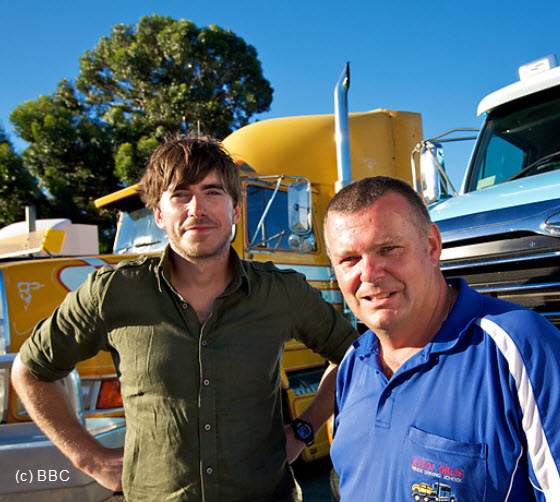
Fomer ‘bin man’ Stephen Mutch with Simon Reeves before his trucks giving him and his wife a much deserved new lease of life

It was fascinating to watch Simon Reeves excellent BBC2 series portraying, among other things, former Hull City Council ‘bin man’ Stephen Mutch making good by educating new lorry drivers in the BIG PLACE (Australia).

After learning that his hours and salary were going to drop by two thirds, he took his destiny into his own hands and took a great leap into the unknown. That unknown being a territory fertile with new job opportunities for those ready to knuckle down and graft.

The programme took a revealing look at life in Australia and the opportunities that exist for people ready to make a new start and dedicate themselves to a new way of life. And what a life!

Through sheer hard work and entrepreneurial spirit he has achieved a lifestyle he and his wife could only dream of when working for the council.

The programme showed Kalgoorlie and its gold super pit, the vast mining and mineral wealth now feeding China’s insatiable consumer appetite, and an experimental blue fin tuna farm. These are just some of the many new employment opportunities available for anyone ready to throw themselves in at the deep end.

This story is a lesson in humility. It is so easy to pidgeon hole people and leave them by the way-side, when they possess latent potential. We all possess latent potential; we just need a spark to ignite it and the opportunity to let it blossom. Not only do we need to do more as a country to nurture this kind of spirit here, but we should also be helping people working in struggling industries emigrate to Australia to relieve the pressure on our own unemployment.

This is not as crazy as it sounds; 565 Spanish job hunters have found work with German companies struggling to fill posts in just the last 12 months thanks to a concerted initiative between those two countries.

Read Full Post »

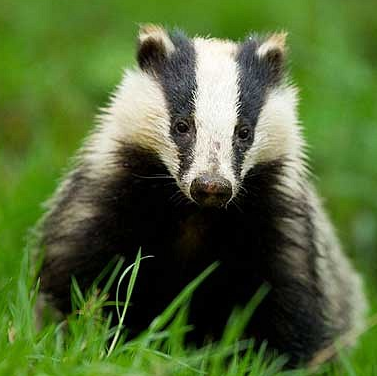
The badger – an icon of the English countryside set to disappear?

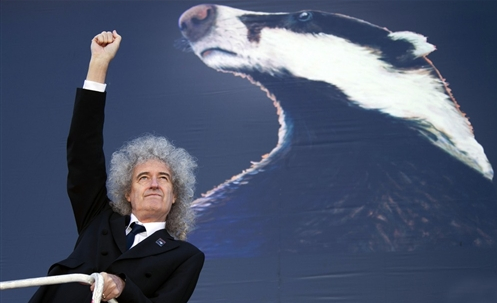
Sir David Attenborough, Simon King OBE and Brian May CBE of rock group Queen are resisting the move by government mandarins to cull 70% of badgers from the English countryside. Attenborough’s and King’s outcry combined with May’s petition is a welcome boost to the Badger Trust’s efforts to save this iconic creature from mass slaughter.

Many leading scientists have stated that a cull this autumn will not work and may even increase the spread of bTB (bovine tuberculosis). The majority of scientists agree that the vaccination of badgers and cattle is a far better and more cost-effective option.

It’s science not sentiment that’s driving our opposition to the Government’s policy to cull badgers in Gloucestershire and Somerset this autumn.

Sir David Attenborough and Simon King OBE

Licenses were granted last week for pilot culls in Gloucestershire and Somerset. According to one of the government’s advisers, there is no real way of knowing how many badgers there are in any given area and therefore no way of measuring whether the 70% target has been achieved or not. They may end up killing them all!

The question is this: who would you rather believe? Attenborough – a man whose proven track record is to preserve nature (including cattle) or the mandarins of power that for reasons of public opinion “need to be seen to be doing something”.

Brian May defiant against government plans to cull the badger

Plans to cull badgers in Wales were recently abandoned in favour of vaccination and there are no plans to cull in Scotland. So why does it make so much sense in England?

If you are against this cull, sign Brian May’s petition posted on HM Government’s e-petition site.

UPDATE: According to the BBC, Natural England has issued a second licence allowing farmers to shoot badgers.

Read Full Post »

Proud Mary

It’s not quite over yet – the Paralympics are still to come – but I just need to say how proud it feels to be British after such a wonderful Olympic Games. I felt so uplifted, especially after the breathtaking closing ceremony – yet another fine celebration of Britain’s cultural influence on the World.

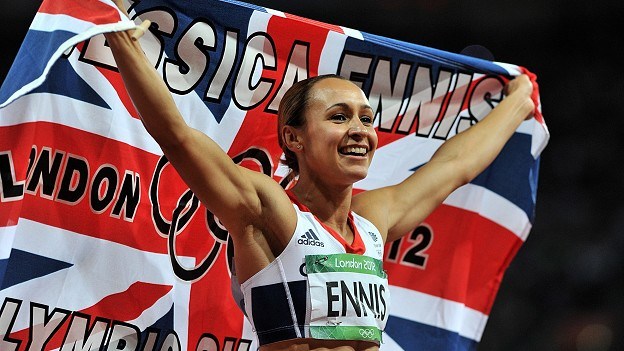
Triumphant Ennis after Heptathlon Gold

I never, ever thought I would become a “couch potato”, but my curiosity, then desire to watch ‘Mo’ and Jessica, mushroomed into a compulsive binge to consume as much BBC Olympic coverage of our athletes as possible. What excitement! What a feast! I don’t normally follow sporting events.

What a joy to witness the skill and sportsmanship of these and other athletes. From mountain biking, road racing, sailing, athletics, equestrian events; I was rooting for them all of the way! By the way, where did all those cheering and flag waving millions lining the roads come from?

The impact from the drama, excitement and pure pleasure on the British psyche has been phenomenal. What a powerful unifying force for our nation! Athletes of all creeds and colour striving for a common goal: to give their best for Great Britain, pumping patriotism to an all time high with it. Let’s hope we can harness all these positive vibes through these difficult economic times.

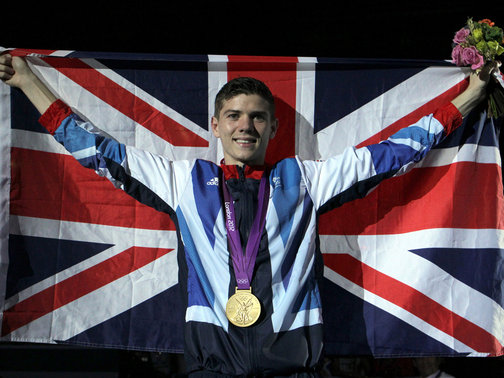
Hull’s Olympic boxing champion – Luke Campbell

Kingston-upon-Hull’s own Luke Campbell – gold medal bantam weight boxing Olympian – will receive further accolades when he returns home. What a hero!

Psychedelic Olympic Stadium

Hats off to Danny Boyle’s Olympic ceremonies. What proud moments so skillfully executed. I loved the psychedelic and special effect lighting in the closing ceremony. And did anyone spot the sudden appearance of a tightrope walker? Imagine the stress of performing that feat in time with the rest of the show. Timed to perfection.

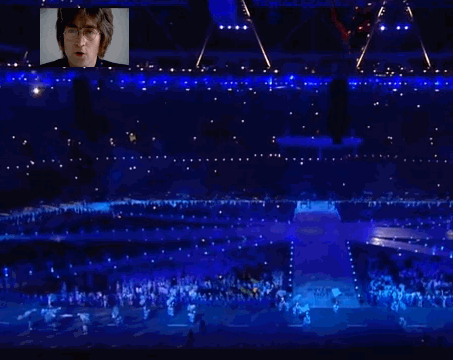
John Lennon’s Imagine, as you have never seen it before

John Lennon’s Imagine was a touching nostalgic note too along with the Who and other pop bands… one of our strongest cultural exports. Britain’s lasting impression on the World. And where did the octopus spring from? Magic! The athletes seemed to be enjoying the free concert in the centre.

I was amazed that over seventy thousand volunteers participated in the Games and was glad to see their recognition heartily applauded. Their good nature and humour said it all.

Now it’s over to the Paralympics and then off to Rio. We wish them all the very best. Looking forward to it.

Read Full Post »

That’s the only description I can muster for the magnificent presentation of the Opening Ceremony of the British 2012 London Olympics – a superb portrayal of our very own sense of Britishness.

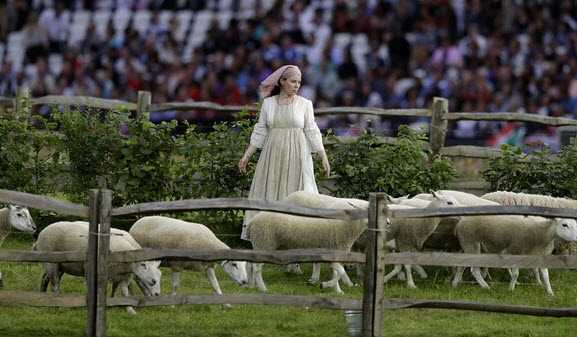
Britain’s pastoral heritage portrayed at the London 2012 Olympics

I wonder whether the thousands of excited international visitors in the audience fully understood the sheep reference and its relationship to the British and its laws! As an island nation, the extensive permanent grassland, moorland, and woodland pastures enabled relatively large numbers of animals to be kept, encouraging the development of pastoral farming in the 13th century. Just one century later, sheep farming had emerged as a cornerstone of foreign trade and national policy through wool exports to Europe. Common law, a pillar of the British legal system, stems from the rights of tenants and others to graze their livestock on the Lord of the Manor’s or public land known as a “commons“, which gave rise to the term “commoner“. The House of Commons was traditionally composed of commoners. So although it may seem frivolous to portray Great Britain through its pastoral heritage, sheep truly did play an instrumental role in shaping British society from the 13th century through to the Industrial Revolution.

We are truly a melting pot of nations and influences when you consider the progressive integration of cultures over the last two millennia – the Romans (Italians), the Angles, the Saxons and the Jutes (Germans), the Vikings (Danes), the Normans (French, descendents from the Vikings!) and more recently the post-war colonial integration of Pakistanis and Indians. It’s this mix that gives us our sense of humour and self-derision. After all that history of invasion, we tend not to get too excited about things and just get on with life, come rain or shine.

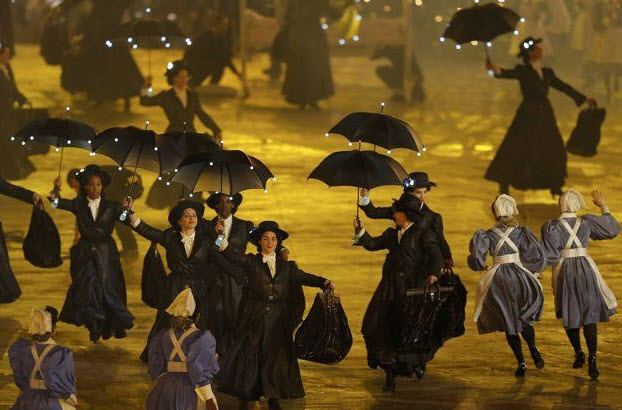
Mary Poppins at the 2012 London Olympics Opening Ceremony

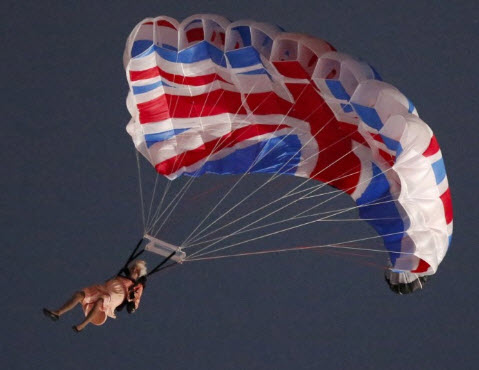
And as if it needed proving, Mary Poppins preceded the Queen and James Bond in their respective heavenly descents into the magnificent stadium. What a good “sport” the Queen was to agree to such an “escapade” and what a joy to receive her welcoming tribute to the Opening of the Games.

The Queen parachutes in style to open the London 2012 Olympics

The 2012 Olympic celebration is vastly different from the one I experienced with my family in Munich in 1972. My memories of that event are just as fond, even though we witnessed at first hand the horror of the terrorism that was to develop over the following decades.

Read Full Post »

Older Posts »