Feeds:
Posts
Comments

Archive for April, 2015

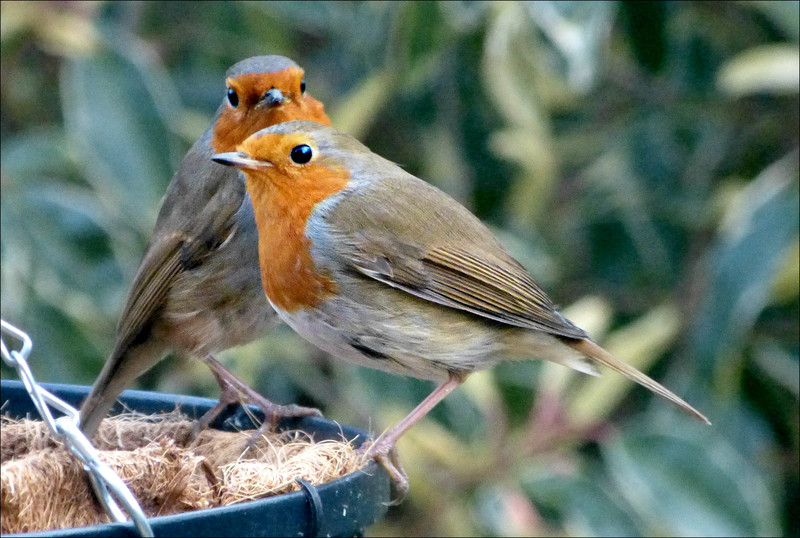
Photo credit - sandiquiz

Photo credit – sandiquiz

Gathering in the washing from the line this afternoon, I was greeted by that cheery chirp of the garden or European robin.

Actually calling him “robin redbreast” is deceptive, because it has a distinctive orange breast. This is because the colour orange was unknown in the English language until the 16th century.

The European robin is one of many species originally described by Linnaeus in his 18th century work. It prefers spruce woods in Northern Europe, contrasting with its preferences for parks and definitely gardens in our British Isles.

The robin is considered generally to be the gardener’s “friend” and for reasons of folklore – should never be harmed! They are generally unafraid of people and much drawn to human activities involving the digging of soil, in order to look for grubs and worms. My cheery garden friend is no exception and follows me around to see if I am going to unearth a wriggly accompaniment to the daily allocation of sunflower hearts I distribute. The robin can also be a night “flitter” and has been observed actively hunting insects on moonlit nights.

Would you believe European robins can be found in Fuerteventura. Very surprising, as the species does not breed either on that island or on neighbouring Lanzarote. They are actually wintering on the islands or just passing through during migrations between Africa and Europe.

Which makes me wonder… has “my” garden robin just arrived from Lanzarote?

I will never know. But it surely does.

Read Full Post »

Are ants political?

imageAnts are fascinating creatures. I watched one scupper across my table, avoiding the sugar I had mischievously placed in its way. It had a higher purpose. An objective beyond the game I wanted to play with it.

Ants start life as an egg. If fertilised, the progeny will be female. If not, then male – in itself quite amazing. I wonder what that says about male ants ! Their lives are the shortest – just 3 years, whereas queens can live for up to 30 years.

Ants can form colonies of varying sizes – from just a few living in a crack in the wall, to highly organised colonies of millions that infiltrate large territories.

They are socially ‘engineered’ with mathematical precision – workers, soldiers and other specialists. New workers spend the first few days of their adult life caring for the queen. Young and ‘graduate’ ants dig and do house work.

Ant society has divisions of labour, communication channels and an ability to solve complex problems. Each member of the community knows its place, its role, its purpose. There are no cases of unrest, disorder, strikes or mutiny. Their instinctive ability to modify habitat and tap resources and defend themselves is something we humans observe in awe.

image

The last TV debate – reinforcing divisions rather than advancing the debate

They exist for their mutual success. They are selfless. Humans on the other hand are self-aware so motivated by individual success. And this I suppose, is why our society will never function in the same way. Maybe that’s a good thing, but at times, when I watch the news and political debates like the last one, I do wonder.

Ants execute a social formula. A social formula that can only be embedded in their DNA. Otherwise how do they acquire it ? They have no forum for debate, no democratic elections, no opposition. They enter life and just get on with it – and do extremely well.

Ants seem to be born with politics – the same politic – in their ‘souls’ for the service of the community at large. Now that’s something all politicians can learn from.

Read Full Post »