As the Boeing 737 approached Berlin Schoenefeld, a grey sheet of cloud replaced the blue skies of the North Sea with fluffy cumulus nimbus that clouded our view and cleansed the city air with sheets of rain.
I got drenched dashing across the airport tarmac and arrived at Motel One soaked to the skin. Fortunately the rain had cleared by the end of the morning.
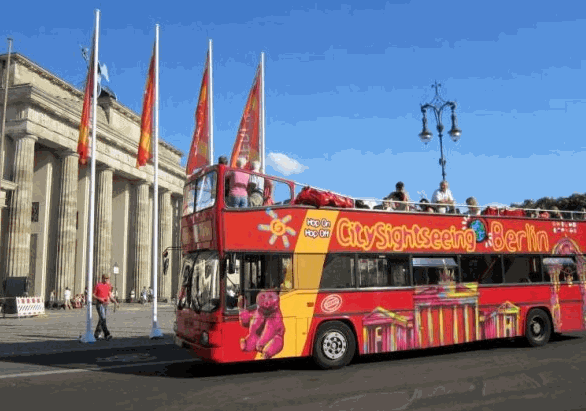
Open-top Berlin bus tour in front of the Brandenburg Gate in warmer, drier times.
Like all good visitors to a city, I took a trip on an open-top tour bus and the rain came along for the ride. By lunchtime, a stop for a Gorgonzola salad washed down by Moselle in the Café Einstein was in order and the Unter den Linden district was the highlight of the day. I returned to the hotel by taxi because rain and open top buses do not mix well. It was time to prepare for the next leg of the coach trip through farmlands and forests and see the ongoing restoration of towns and villages.
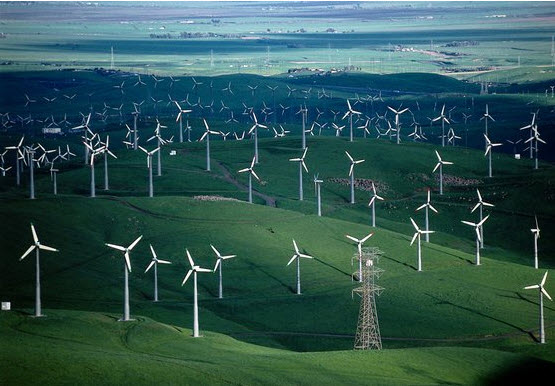
The wind farm invasion
That’s when it hit me! Fields of gargantuan wind turbines ruptured the tranquil prairie landscape of wheat and crops. What’s more, only a handful seemed to be working. It would have been easier to accept these eyesores, if they were actually working and doing some good. Fortunately, the journey was punctuated with woodland and forests that helped soften the landscape.
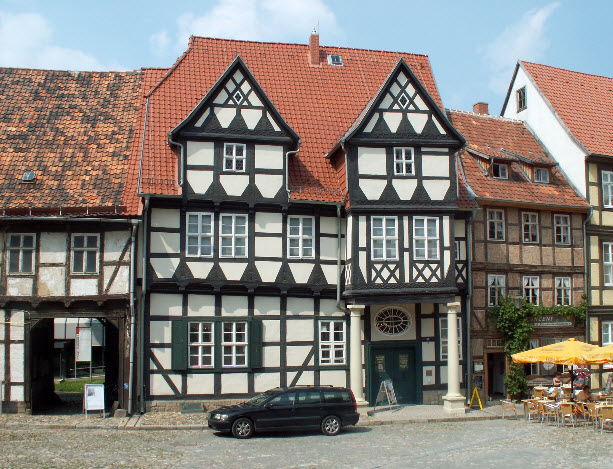
Quedlinburg’s half-timbered medieval architecture
It was a relief to arrive in Stendal north Saxony. Days later it was destination Quedlinburg with its castles, medieval architecture and 1200 conserved half-timbered houses, which lead to the town’s addition to the World Heritage List. English was not spoken here with the exception of our guide – a monk with a perfect command of the Queen’s English! Turned out his guise was for the tourists and not for the ‘Love of God’ as he was not from the local monastery. As we drove through the vast forested regions of the Harz mountain range, I realized how essential rain was to their survival.
Still, the wind turbines continued to invade the otherwise picturesque landscapes.
And then it dawned on me – how powerless we are against the elements! We plant fields of wind turbines in the hope of making an impact on the world’s climate. Maybe, just maybe, if every nation on the planet cultivated wind farms the size of counties; we might just generate enough energy to reduce carbon emissions… a little. That is, as long as there is wind. The scale needed for wind farms to have any impact is frightening.
Back in sodden England, (with all my personal effects) “Mary, Mary quite contrary” realises that it is not “silver bells, cockle shells and maidens all in a row” that makes her garden grow… it is RAIN, which helps put things into perspective.


 Mary's Blog
Leave a comment